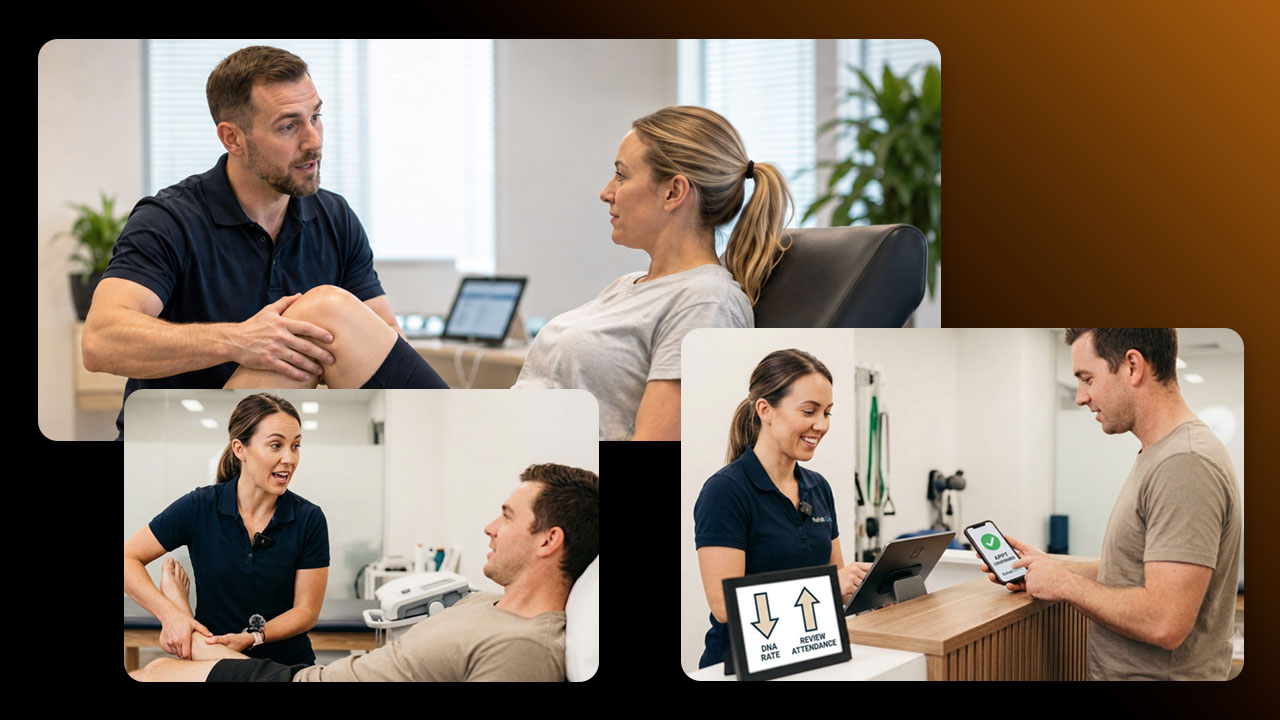
Everyone talks about AI note-writing as a time-saver. Fair enough, it is. Ask any physio using it properly and they will tell you they are getting an hour a day back. But after months of using Rehab Guru's AI note-writing in my own clinic, and comparing notes with friends and customers who have done the same, I have noticed something nobody predicted. The real win is not the time saved. It is what happens to the patient in the room while the note is being written.
Most people assume the communication benefit of AI scribing comes from history-taking. You are more present, more eye contact, less time typing while your patient talks. That is true, but it is not where the real shift happens.
The bigger change is in the physical exam
Rehab Guru's AI writes the objective assessment far better than anything else I have used. To get that quality of output, you need to actually say what you are doing. What you are observing. What you are feeling under your hands. What each test shows and what it means. You are not narrating for the software's benefit. You are narrating so the note is accurate. But the patient is standing right there, listening to every word.
And it turns out that narration is exactly what patients have wanted all along.

Think about what a physical exam usually looks like from the patient's side of the plinth. Someone presses on your back, moves your leg, asks you to push against their hand, and says very little. You do not know if what they just found is good news or bad news. You are left guessing until the summary at the end, if you get one at all.
When you talk through what you are seeing and feeling, in real time, for the sake of the note, you are inadvertently giving the patient exactly what they wanted from the whole appointment. They are not waiting until the end to feel informed. They feel seen and heard from the first minute of the exam onwards.
That is not a small thing clinically. Patients who understand what is happening to them develop trust faster. Trust translates into engagement with the treatment plan and the home exercises you give them. And engagement is the single biggest lever we have over rehab outcomes.

Here is the bit that surprised me most, and several colleagues report the same pattern: a noticeable drop in did-not-attend rates for review appointments.
Think about why patients usually fail to attend a review. Often, they book it under duress at the end of the first session. They are not against your version of healthcare, but they are not convinced either. They leave the room without a clear sense of what is wrong, what the plan is, or why they should believe it will work. So the booking is a formality, not a commitment. And when the day arrives, it is easy to cancel or simply not turn up.
Compare that to a patient who has been talked through the exam step by step. They have heard the reasoning, not just the conclusion. They understand their diagnosis and they believe in the plan, because they were present for how it was built, not just told the outcome. They are not rebooking under duress. They are rebooking because they want to know what happens next.

None of this was designed into the product. Nobody set out to build a communication coaching tool. But that is effectively what has happened. AI note-writing has forced clinicians, unknowingly, to narrate their clinical reasoning out loud, and patients are responding to it exactly as you would expect people to respond to being kept informed about their own bodies.
It is a useful reminder that the biggest gains from a new tool are not always the ones on the feature list. Sometimes the side effect is the headline.
Put together, the pattern looks like this:
If you are already using AI note-writing and have not noticed this, try being deliberate about it. Narrate your exam findings out loud, for the note and for your patient. It costs you nothing extra. You are speaking those words anyway, just directed at software instead of the person in front of you. Point them at both, and the clinical documentation is not the only thing that improves.